
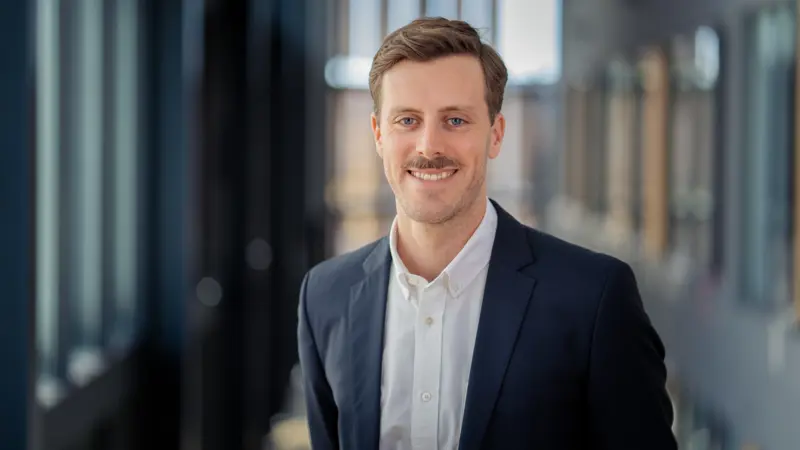
Having recently joined Storebrand Asset Management as a Senior Sustainability Analyst in the Risk & Ownership team, Georg Präauer brings extensive experience from international engagement dialogues and norm-based research. In the following interview, Präauer shares his perspectives on regulatory developments, the power of active ownership, and what drives his passion for sustainability.
– You’ve led engagement dialogues with companies facing complex issues ranging from environmental concerns to human rights challenges. Looking back, which of these experiences do you think will resonate most with Storebrand AM’s clients?
– In my previous role as Engagement Manager at ISS STOXX, I conducted reactive engagement dialogues on behalf of investor clients with companies identified for violations of global norms. In addition, I was involved in proactive engagement on several sustainability topics such as net zero. Active ownership is a key focus at Storebrand, and I believe my background can help further develop this work. Among other things, I bring analytical skills and topic knowledge of various norm areas within responsible business conduct that are relevant for screening and exclusion of companies as part of the investment process.
– With EU sustainable finance regulation evolving so quickly, what impact do you think these changes will have on the way Storebrand AM supports its clients in navigating this new and often complex landscape?
– Regulation is important to establish a minimum baseline, and we’ve seen significant regulatory developments in the industry in recent years. However, more recently upcoming or already implemented regulations have been diluted. While in principle we believe that some efficiencies can be realized through streamlining regulations, it is important to retain the core ambition and standards they have introduced. Also, as a leader in sustainability, Storebrand’s ambition is to address sustainability issues that are not or are insufficiently covered by regulation.
– Much of your career has involved working with companies to encourage transparency and real change following norm violations. In your view, how powerful can active ownership be in driving results that matter not only for companies, but also for investors?
– For responsible investors, the point of departure is that companies are expected to respect global norms for responsible business conduct. Active ownership can be a very powerful tool to help achieve this if a long-term perspective is taken and common ground between a company and investors can be established. Moreover, collaboration among responsible investors plays a critical role in advancing these objectives and increasing the mandate. However, it’s also important to acknowledge the limitations of active ownership, be realistic about the asks in a dialogue, and be mindful of the particular circumstances. For example, it will make a difference whether a company is controlled, what the specific shareholder rights or culture are in a country, and whether the issue is material to the company.
– Sustainability today is increasingly data-driven, yet numbers alone rarely tell the full story. How do you believe the combination of ESG data and meaningful company dialogues can create real value for clients?
– The abundance of available data is undoubtedly a beneficial development, yet it also introduces potential challenges such as the risk of noise and misinterpretation. Despite much better ESG data availability, a key issue is that irresponsible business conduct still flies under the radar, as it might occur in jurisdictions with weaker regulation, media, or civil society. Consequently, our sustainability team recognizes the importance of complementing ESG data with comprehensive fundamental analysis. Particularly within active ownership, data might be the starting point for engagement with a company, but ongoing dialogue is often crucial to understand how a company addresses an issue and to establish relationships that can facilitate meaningful real-world change.
– What drew you to Storebrand AM, and in what ways do you hope to help shape the company’s journey toward even stronger responsible investment practices?
– Having followed Storebrand over the years, I’ve always been impressed by the company’s focus on sustainability. There is an incredible wealth of knowledge in the Sustainability Team, which has done pioneering work on issues such as human rights risks in conflict-affected and high-risk areas or policy engagement on nature issues. At a time when anti-sustainability winds are blowing stronger, I believe it is more important than ever for responsible investors to reinforce their position, highlight their investment approach, and stand firm in their commitments and values – despite evident challenges. I aim to contribute so that Storebrand will not only maintain its leadership in sustainable investments but also set new benchmarks for the industry’s future.
– Sweden is often seen as a frontrunner on sustainability, yet every country faces its own unique set of challenges. From your perspective, what are the most pressing sustainability issues Sweden needs to address in the years ahead?
– Sweden certainly has many companies that are at the forefront of driving the sustainability agenda, and there are strong institutions and a strong civil society that guards stakeholder rights. However, in recent years politics has fallen behind and sustainability ambitions have been lowered. For example, while territorial greenhouse gas emissions have generally declined for many years, preliminary data shows that emissions in 2024 have actually increased by 7%, which is a very worrying development. The Swedish government has also lobbied against sustainability regulation at EU level (e.g., corporate due diligence and deforestation). Innovative companies that address sustainability issues are essential to raise the bar, but to move the wider market, clear political will and direction are needed.
– Many people working in sustainability can point to a moment or personal experience that shaped their commitment to this field. Is there an event or memory from your own life that made you truly realize the importance of sustainability and ESG?
– Growing up in a village in the Austrian Alps gave me a strong connection to nature and a passion for outdoor sports. But I could also witness the impacts of climate change on the Alps’ sensitive ecosystem, such as melting glaciers and warmer winters. For my professional career, I wanted to work in a field that is part of the solution to this and other sustainability issues. While it sometimes feels a bit abstract and far from the “real world,” investors have a crucial role and responsibility to address these challenges. For me, the sustainability field is an incredibly exciting professional area as it evolves so quickly. However, this also means that new challenges arise every day, keeping one humble and constantly learning. And while there is this constant inevitable feeling of doing too little, too late, aiming to be part of the solution motivates me.

This is Georg’s hometown, Zell am See, in the Austrian Alps, with the melting glacier on the Kitzsteinhorn in the background. Photo credit: Zell am See-Kaprun Tourismus GmbH