
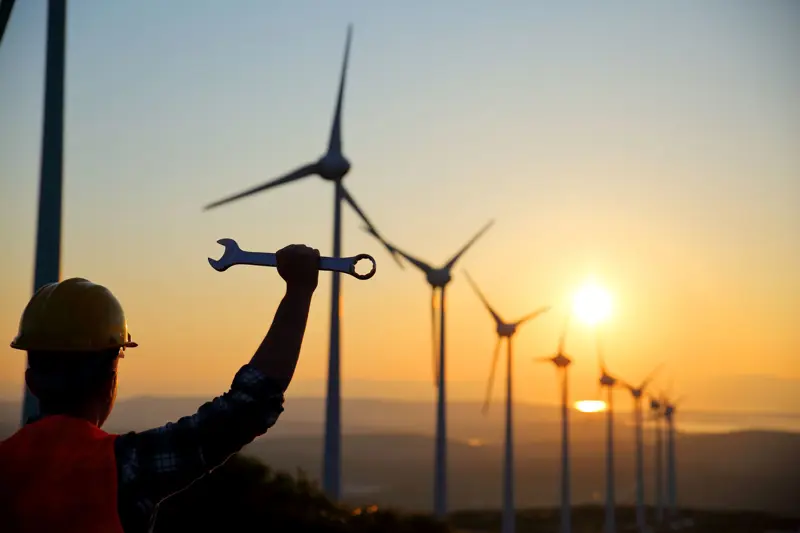
“Energy security is one of the most critical issues in building resilient and robust societies today. As part of the financial sector, we can contribute by directing investments toward strengthening these critical infrastructures” says Philip Ripman, Head of the Solutions team at Storebrand AM, which includes the Storebrand Renewable Energy fund.
Well positioned for sector tailwinds
The electrification of transport, industry, and data centers is sharply increasing electricity demand, while many countries aim to strengthen their energy security and reduce emissions.
Together, these factors point to sustained long-term growth in energy system investments.
“For investors, this creates a sector propelled by several powerful trends simultaneously, climate policy, technological innovation, electrification, and energy security”, continues Ripman.
Electrification plays a key role
A fund offering exposure to this development is Storebrand Renewable Energy. The fund invests in companies across the entire renewable energy value chain, both producers of clean energy and firms developing the technology and infrastructure needed to store, transport, and use energy more efficiently.
As more areas of the economy electrify, the need for investment in grids, energy storage, and new energy production continues to grow.
"Electrification plays a key role in decarbonisation by shifting energy use toward low‑carbon electricity. Enabling this requires parallel investment in grids, storage, and power generation", Ripman adds.

Philip Ripman, Portfolio Manager and Head of the Solutions team at Storebrand AM.
After a challenging period, the sector has performed strongly over the past year. Yet the perspective remains long term: the energy transition is a structural shift expected to unfold over decades, driven by electrification and the global demand for stable, low emission of energy.
According to the International Energy Agency (IEA), global energy investments amounted to around 3.3 trillion dollars in 2025, of which approximately 2.2 trillion went to clean energy. This is roughly twice the level of investment in fossil fuels.
“With Storebrand Renewable Energy, we take a strategic position in the transition and see the fund as a natural component of a long-term portfolio”, Ripman concludes.
Facts Renewables & Energy Security
1. In H1 2025, renewables overtook coal in global electricity generation for the first time ever Ember — 34.3% vs 33.1%. (Ember, Jan 2026)
2. In the first three quarters of 2025, solar and wind together met 100% of global electricity demand growth. EMAPTA Every additional unit of power the world needed came from clean sources. (Emapta / Ember, 2026)
3. Global energy investment hit a record $3.3 trillion in 2025, with $2.2 trillion directed toward clean energy. World Resources Institute (WRI / IEA, Dec 2025)
4. Spain's wholesale electricity prices were 32% lower than the EU average in H1 2025 Ecohz, largely because solar and wind displaced more expensive gas and coal. (Ember via Ecohz, 2026)
5. After China restricted rare-earth magnet exports in April 2025, shipments fell 74% year-on-year GQG Partners — forcing temporary shutdowns at factories including Ford's Chicago plant. (GQG Partners, Nov 2025)
6. China refines 90% of global rare earth elements and 60–70% of lithium and cobalt Security Council Report — even where it doesn't mine them. (IEA via UN Security Council Report, Mar 2026)
7. Guided weapons systems use 18 different critical minerals; combat aircraft use 15; naval warships use 14. J.P. Morgan (J.P. Morgan, 2026)
8. The Pentagon became the largest shareholder of MP Materials J.P. Morgan — the only fully integrated rare earth magnets producer in the US — to secure domestic supply. (J.P. Morgan, 2026)
NOTE: Investments involve risk. Historical returns are no guarantee of future performance. Money invested in funds can both increase and decrease in value, and it is not certain that you will get back the entire invested amount. Fact sheets and information brochures can be found on our website.