

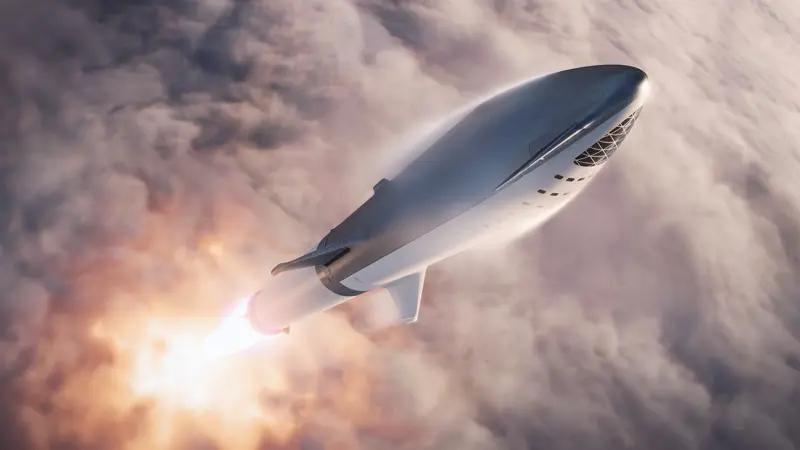

On Friday 12 June, the stock began trading on Nasdaq under the ticker SPCX. It was priced at 135 US dollars, giving a valuation of around 1.77 trillion US dollars and raising 75 billion US dollars – the largest capital raise ever. On its first trading day the share rose 19 percent to about 161 dollars, and was up more than 30 percent at their peak. By the close, the market capitalisation stood at around 2.1 trillion US dollars, and the listing made Elon Musk the world's first trillionaire. Trading volume was exceptionally high.
The listing comes at a time when several of the world's most talked-about technology companies are considering going public, but SpaceX stands out in both size and complexity. The company brings together some of the most ambitious projects in spaceflight, satellite communications and artificial intelligence within a single business.
Three businesses in one company
In practice, SpaceX consists of three very different businesses: satellite internet through Starlink, the launch business, and the AI company xAI.
Starlink is by far the most profitable part of the business and has grown rapidly in recent years. The launch business has established SpaceX as the dominant player in commercial spaceflight, while xAI represents the company's bet on artificial intelligence and future AI infrastructure.
Together, this gives SpaceX a unique market position. At the same time, it means that investors are not only buying exposure to a single business area, but to several businesses with very different risk and profitability profiles.
A valuation that requires a lot to go right
There is little doubt that SpaceX has built significant competitive advantages. The question is whether these alone can justify the price tag.
Even the pricing at around 1.77 trillion dollars implied high expectations for future growth, and after the first trading day the company is valued even higher – around 2.1 trillion dollars. Starlink must keep growing strongly, the next generation of rockets must succeed commercially, and several of the company's long-term ambitions in AI and computing must become profitable.
Several independent analysts have therefore estimated a fair value significantly below the listing price – Morningstar, for example, has pointed to around 780 billion dollars. For investors, this means that much of the expected success may already be priced into the stock, and the sharp jump on the first trading day underlines how high expectations are.
What does this mean for you as an investor in our funds?
For index investors, SpaceX is not only a story about spaceflight and artificial intelligence. It is also a story about index mechanics. With a limited free float at listing and the gradual release of shares held by insiders, mechanical capital flows can have a major impact on the share's performance in the period after the IPO. The sharp rise and the high volume on the first trading day – with a free float of only around 4 percent – illustrate precisely this dynamic.
Storebrand AM mainly tracks MSCI indices, not Nasdaq indices, which give SpaceX an index weight far higher than free float alone would warrant. This means that we largely avoid the most aggressive buying dynamics that can arise when very large companies are included in certain US indices.
Where SpaceX is included in our benchmark indices, we will build the exposure gradually, with a focus on the best possible execution for our clients. We are not forced to buy the stock at a particular point in time if market conditions suggest that this is not the most appropriate solution.
For us, the SpaceX listing is therefore interesting for several reasons. Not only because the company is remarkable, but because the IPO illustrates how index inclusion, capital flows and valuation can affect investors' returns.
Read the full analysis for a deeper review of the valuation, the index mechanics and how we at Storebrand AM assess the SpaceX listing.