
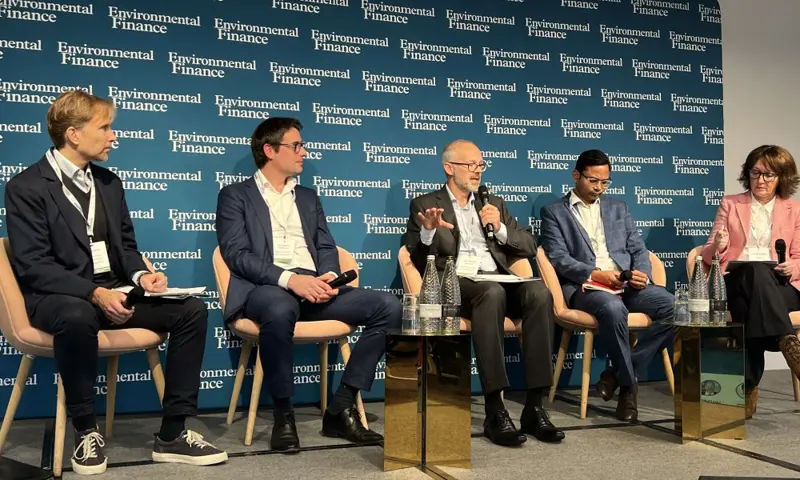
Emine joined a panel entitled ‘How can nature-related data be used by the investment industry?’ She outlined the four ways that Storebrand uses data; risk assessment and management, investment decision-making, monitoring companies and performance, and for compliance and regulatory purposes. Emine also commented that although nature data is abundant, the challenge for asset owners, investors and companies is usability – “the industry needs to understand better what it measures and what it doesn’t.”
She also highlighted the important role that data plays in engagement given that companies often face very different nature-related drivers and challenges, “Data should form the basis for tailoring any engagement strategy so investors can have actionable and meaningful dialogue, and it is also in the companies’ interest to better understand their relationship to nature,” while also acknowledging its importance from a more macro perspective, “Investors and industry initiatives also play a key role in enhancing market access to data, especially at a time when there is so much pushback against ESG and regulatory uncertainty.”
Emine drew a distinction between climate data analysis which tends to be much broader in its scope. “Nature is very location and sector specific, so it is important to compare companies with peers rather than the broader universe. I also find that companies are interested in engaging with data providers and challenging them if they think their assessments are wrong. There is often an interesting dialogue between companies, data providers and investors.”
Data developments
The panel also discussed the rapidly evolving data environment and expected improvements in information access and quality. Emine highlighted the Finance for Biodiversity Foundation’s work to help define transition companies as an exciting development that would provide significant benefit to the financial community. “In the climate space we have a very clear understanding of what a transition company is, which we don’t have in nature and that makes it more difficult when dealing with listed companies to identify solution providers.” She also emphasised the importance of technological advancements to help companies and their investors. “I’m hoping to see a deeper integration of nature data in future and believe that technology is going to help us go beyond disclosure and provide a better understanding of actual impact.”

Twin transition
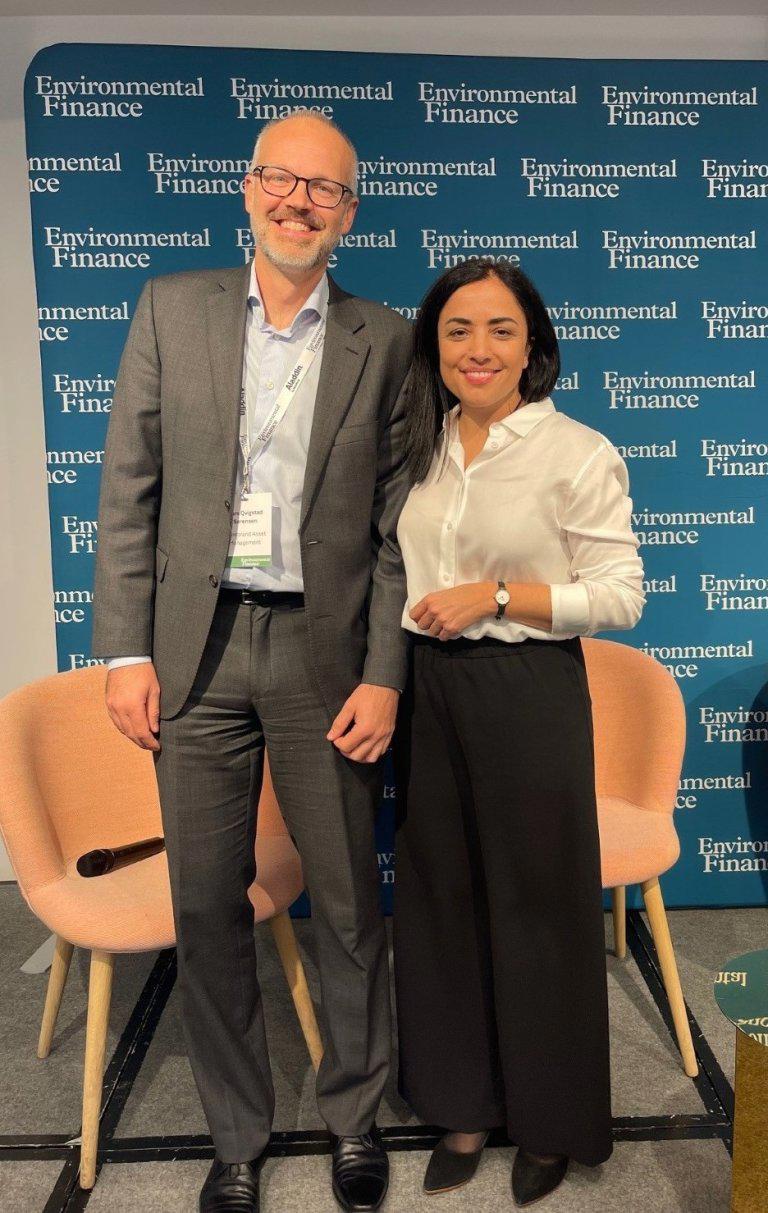
Lars Qvigstad Sørensen later joined a conference panel on ‘Integrating climate and nature risk and the associated data challenges.’ Lars outlined Storebrand’s role in contributing to the ‘twin transition’ of decarbonising the economy while preventing biodiversity loss: “By contributing more capital to climate and nature positive companies and less to those we believe have negative impacts, we invest in line with the Paris Agreement, which prescribes allocating capital to low emission and climate resilient companies, and are also aligned with the Global Diversity Biodiversity Framework’s Target 14 to integrate biodiversity in decision-making at every level.”
He explained how Storebrand’s twin-track approach means that climate and nature are seen as being deeply interconnected, whilst acknowledging that there are data differences. “When it comes to climate data there is broad consensus on the risk metric of CO2 equivalence and the disclosure of scope 1 and 2 emissions in order to reach a single goal of limiting global warming to 2 degrees. For nature data, however, we don’t have the same agreed metrics or drivers, and the picture is further complicated by complimentary but competing measures which means they diverge and cannot be easily compared to benchmarks and competitors like emissions metrics.”
Lars also highlighted the importance of addressing the trade-offs that are often inherent when integrating climate and biodiversity into investment frameworks. “We have excluded hydro power companies from our investment universe because they contributed to habitat loss.”
Data collaboration
The panel also discussed the benefits of external data vendors and investors working together to improve outcomes. Lars explained how Storebrand has previously worked on an ‘agile development cycle’ with data providers which proved successful, and suggested there are three conditions to achieve positive results: “We need transparency to help explain to clients what we are doing, granularity as biodiversity loss is location-specific, and comparability to enable investors to differentiate between companies.”
Looking further ahead and what success might look like in five years’ time for tackling climate and nature risks, Lars emphasised the need to see a conducive political environment alongside achieving competitive financial returns. “By 2030, I hope that climate and nature risks are integrated into financial decision-making, not as add-ons but fully embedded as part of fiduciary duty.”
