
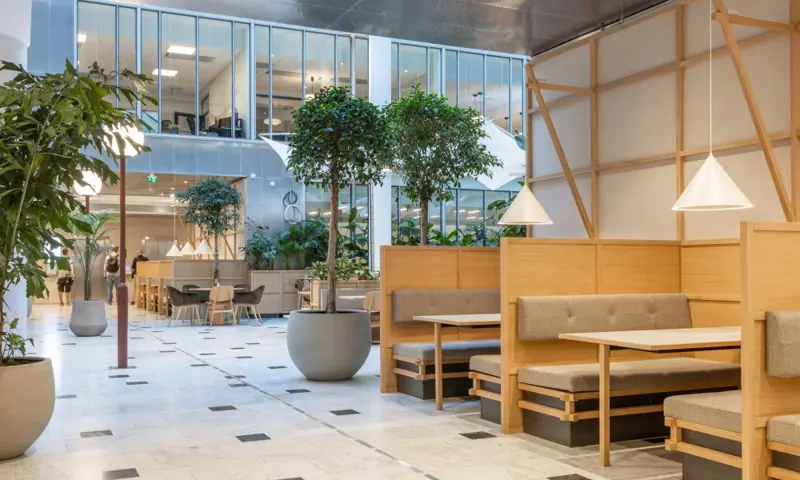
In the heart of urban development lies a story of transformation and sustainability, spearheaded by Storebrand Real Estate. The recent feat of reusing 900 tonnes of building materials in the renovation process isn't just an accomplishment: it's a bold statement in the property sector.
If we were to only construct brand-new high-standard "sustainable" buildings, we would be missing a crucial point. At Storebrand, our view is that the real estate sector has a pivotal role in meeting global sustainability goals. One of the most important of these goals is the 1.5°C target set in the Paris Agreement, which calls for countries to take concerted climate action to reduce greenhouse gas emissions.
To get there, new buildings aren't always the answer, and the principles of re-use and the circular economy take on more importance than before. It's about improving what we have and consciously making strategic decisions that are aligned with our environmental goals.
Sustainability and going beyond the balance sheet
Taking that approach is reflected in our performance in external assessments. Storebrand Eiendomsfond Norge's jump from 92 to 94 points in the GRESB (Global Sustainability Benchmark for Real Assets) is more than a numerical increase – it's a testament to a profound shift in real estate thinking. From a modest GRESB score of below 50 points seven years ago, to leading the global charts among over 300 portfolios today, Storebrand's journey is nothing short of remarkable.
The surge in customer interest around environmental and social issues is reshaping the investment landscape. Investors are increasingly keen to understand how their capital affects the broader world. Storebrand Real Estate doesn't just respond to these inquiries; they set the bar. They're not only showing what they're doing and evolving but also how they're outperforming their competitors.
GRESB's focus on concrete results offers crucial insights. It's a rigorous validation of our approach and a reminder that our progress is under constant evaluation.
Redefining building standards at Grev Wedels Plass
Storebrand Real Estate's approach pivots on a fundamental principle: improvement over novelty. We don't always chase the newest, most energy-efficient buildings, so elevating a G-rated building to a C-standard is more sustainable than erecting a new A-rated structure. This philosophy extends beyond energy ratings. It's about making conscious choices in materials, recycling, and reuse, ensuring that their environmental footprint is as light as possible.
Take the transformation of the building at Grev Wedels Plass 9, for example. This project in central Oslo was more than a renovation; it was a rebirth. With ambitions for an overall 60 percent reduction in energy usage from construction, the team repurposed materials like porcelain, marble, brick, and glass, integrating them into the building's new design.
All in all, over 900 tons of building materials were reused, while the project had a remarkable sorting rate of 95 percent. The result? A space that's not only modern and efficient but also steeped in a strong environmental ethos.
A call to arms for the industry and beyond
Fittingly, the renovated building at Grev Wedels Plass now serves as the headquarters of Innovation Norway, the Norwegian Government's most important instrument for innovation and development of Norwegian enterprises and industry. It is an important marker of a path forward for the property sector, and arguably for the country.